Sunday, 21 April 2013

Otaku

Otaku ( おたく) is a Japanese term used to refer to those who truly pursue a hobby or second person pronoun in the most polite Japanese standard, the equivalent of the word "anda" in Indonesian.

Since the second half of the 1990s, the term otaku began to be known outside of Japan to mention a big fan of Japanese subcultures such as anime and manga, there are even people who call themselves as otaku.
The term otaku is most likely derived from a conversation between anime fans who always greet the other person as otaku ( お宅 you) which is the most polite form of the second person pronouns in Japanese. In further developments, the term otaku written with katakana characters otaku ( オタク) or wotaku ( ヲタク) to distinguish slang term with a second person pronouns in Japanese standard. 
District of Akihabara otaku gathering place
In the early 1980s there has been a slang term discordant tone byōki ( ビョーキ "sick") addressed to the fan lolicon, manga and manga dōjin. Byōki term dōjinshi is often appears in the anime to the major role of girls like Minky Momo.
The term otaku was first introduced by columnist Akio Nakamori in the article "Otaku" no Kenkyu ( おたくの研究 Research on Otaku) were loaded magazine Manga Burikko. In an article published serialized from June to December 1983, the term used to refer to the otaku subculture such a big fan of anime and manga.
At that time, the general public did not know the term otaku. Mass media who first used the term otaku is Nippon Broadcasting System radio segment that raised Otakuzoku no jittai ( おたく族の実態 situation among otaku) on the radio show Young Paradise. Otakuzoku term (literally: Otaku rate) is used to refer to the otaku, following the existing designation for a group of young people who use the suffix "zoku," as Bōsōzoku and Takenokozoku.

In further developments, the term otaku is used for single men who have a hobby of anime, manga, idol, video games, and personal computers without limitation of age. The term otaku is also used to refer to a lot of single women or married women who formed a little group is "cult" based on a hobby. Among the aged 50 and over who is a big fan of high culture or continue to pursue academic achievement in the field of rare and almost never called otaku.
The term "otaku" in the narrow sense used initially only among the people who have similar hobbies that form a limited circle as dōjinshi publishing. Lately, the term otaku in its broadest sense can often have a negative or positive connotation depending on the situation and the people who use it. The term otaku is used negatively to a rabid fan subculture can not understand the good location of the general public, or people who are less able to communicate and often do not want to hang out with other people. Otaku positively used to refer to people who are very steeped in a field to detail, accompanied by a very high level of knowledge up to the level of an expert in that field.
Before the term otaku became popular in Japan, some people have called "mania" because only pursue something and have no interest in the daily life of common people. In Japan, the term otaku is often used out of context a big fan of anime or manga to replace the term mania, so there is a Game-term otaku, Gundam otaku (otaku about Gundam robot), Gunji-otaku (otaku military field), Pasokon-otaku ( computer otaku), Tetsudo-otaku (train otaku aka Tecchan ), Morning Musume-otaku (otaku Morning Musume aka Mo-ota ), Jani-ota (otaku cool singer who joined the Johnny & Associates).

In derogatif, the term otaku widely used as a term for "man with strange habits and the general public do not understand," regardless of the person to pursue a hobby or not. Girls in Japan often use the term otaku for boys who are not popular among girls, but otherwise this term is never used for women. Since the term otaku is often used in the context of offending, the use of the term otaku is often criticized as prejudice or discrimination against someone.
Also synonymous with the term otaku Akiba Kei used for men in bad taste in the matter of dress. Akiba Kei designation comes from the style of dress of men who would rather spend money on the hobby purposes in the district of Akihabara, Tokyo instead of buying clothes that are trends. Other less common designations for Akiba-Kei-Boy are A or A-Kei, following the term B-Boy (B-Kei or B-Kaji) who had already been there for people who mimic the appearance of hip-hop singer was black.

created by : Calvina

Monday, 15 April 2013

Visit Laos


Laos is one of the few truly exotic travel destinations left in the world. With a 'back-in-time' feel to it and with a truly friendly population combined with atmospheric Buddhist temples, places of interest and enigmatic heritage sites, you are guaranteed a roller coaster of a cultural ride in exploring this country.
From the UNESCO World Heritage Site of Luang Prabang (yes, that's right - an entire town a heritage site) to the unexplained and mysterious Plain of Jars you'll be fascinated and in awe of this wonderful land.

--------------------------------
10 top places in Laos


Luang Prabang - Northern laos
Luang PrabangLuang Prabang, a UNESCO World Heritage Site located in northern Laos, is an important yet charming little town that ranks among the top must-visit destinations in the country. It features former royal palaces and more than 30 temples, old French colonial architecture as well as beautiful natural sites. Read More...


Vientiane
That Luang That Luang, or the Great Stupa, in Vientiane is a national symbol (on Laos’ official seal) and also the most sacred monument in the country. From the outside That Luang looks more like a fortress surrounded by high walls and it features two temples with the main stupa, the top of which is covered with gold leaf, standing 148 feet tall. Read More...


North of Vientiane
Vang ViengVang Vieng is simply a piece of heaven on earth that has attracted many world travelers for years, especially young backpackers. Surrounded by great mountains, rivers, limestone cliffs and rice fields, this small and scenic town offers a long list of interesting attractions. The Nam Song River is where you will witness the infamous 'tubing'. Read More...


Vientiane
Wat SisaketWat Si Saket located in Vientiane is famous for its cloister wall housing thousands of tiny Buddha images and rows with hundreds of seated Buddhas. These images mainly date from the 16th and 19th centuries and come in all sizes and are made from wood, stone and bronze – more than 6,800 Buddhas in total. Read More...


Tadfane WaterfallBolaven Plateau in southern Laos is famous for its great scenery, ethnic villages and unexplored corners. It’s probably best known for being home to some of Southeast Asia's most spectacular waterfalls including Tad Fane and Dong Hua Sao. The plateau’s elevation ranges approximately from 1,000 to 1,350 metres above sea level. Read More...


Bokeo
Mekong river in Houixay, Bokeo's capitalBokeo is a peaceful rural province in northwestern Laos. Rich in natural resources with hilly mountains, tropical forest and farmland, Bokeo is also home to many ethnic groups who still preserve their traditional lifestyles and culture. Read More...


Vientiane
Buddha ParkBuddha Park (aka Xieng Khuan) is a famous park with more than 200 religious statues including a huge 40-metre high reclining Buddha image. It was built in 1958 by Luang Pu Bunleua Sulilat, a monk who studied both Buddhism and Hinduism. This is why his park is full not only of Buddha images but also of Hindu gods as well as demons.  Read More...


Xieng Khouang
The Plain Of JarsThe Plain of Jars is considered the most distinctive and enigmatic of all Laos attractions. The large area around Phonsavan, the main city of Xieng Khouang Province is dotted with stone jars but no one has a clear idea as to why they are there. The mysterious jars were carved from both sandstone and granite in various sizes... Read More...


Champasak
Wat Phu Wat Phu (meaning ‘mountain temple’), is situated on a hillside and offers stunning views over the surrounding land and Mekong River. Visitors who appreciate art and history will be amazed by the magnificent workmanship in this ruined Khmer temple complex in the form of temple pillars, barays, lintels, pediments and more Read More...


That Ing Hang StupaThat Ing Hang Stupa is about nine metres high with beautiful carving and decoration. It’s reported to house a relic of Buddha’s spine. The 16th century stupa is located in Savannakhet, Central Laos. Savannakhet itself is famous as the birthplace of Laos’ popular former leader, Kaysone Phomvihane. Read More...


cc : source
follow me @damnrell a.k.a Darrell Erastania F


Thursday, 4 April 2013

Chinese Zodiac

The Shēngxiào (Chinese: 生肖), also known in English as the Chinese Zodiac, is a scheme, and a systematic plan of future action, that relates each year to an animal and its reputed attributes, according to a 12-year cycle. It has wide currency in several East Asian countries, such as China, Vietnam, Korea and Japan.

Many folk tales and fairy tales that explain the origin of the formation of 12 this sign. The famous one is the following :

"Cat and Rat were the worst swimmers in the animal kingdom. Although they were poor swimmers, they were both quite intelligent. To get to the meeting called by the Jade Emperor, they had to cross a river to reach the meeting place. The Jade Emperor had also decreed that the years on the calendar would be named for each animal in the order they arrived to the meeting. Cat and Rat decided that the best and fastest way to cross the river was to hop on the back of Ox. Ox, being naïve and good-natured, agreed to carry them both across. Midway across the river, Rat pushed Cat into the water. Then as Ox neared the other side of the river, Rat jumped ahead and reached the shore first. So he claimed first place in the competition and the zodiac.

Following closely behind was strong Ox who was named the 2nd animal in the zodiac. After Ox, came Tiger, panting, while explaining to the Jade Emperor how difficult it was to cross the river with the heavy currents pushing it downstream all the time. But with its powerful strength, Tiger made to shore and was named the 3rd animal in the cycle.

Suddenly, from a distance came a thumping sound, and the Rabbit arrived. It explained how it crossed the river: by jumping from one stone to another in a nimble fashion. Halfway through, it almost lost the race, but the Rabbit was lucky enough to grab hold of a floating log that later washed him to shore. For that, it became the 4th animal in the Zodiac cycle. In 5th place was the Flying Dragon. Of course, the Jade Emperor was deeply curious as to why a swift flying creature such as the Dragon should fail to reach first place. The mighty Dragon explained that he had to stop and make rain to help all the people and creatures of the earth, and therefore he was held back. Then, on his way to the finish, he saw a little helpless Rabbit clinging onto a log so he did a good deed and gave a puff of breath to the poor creature so that it could land on the shore. The Jade Emperor was very pleased with the actions of the Dragon, and he was added into the zodiac cycle. As soon as he had done so, a galloping sound was heard, and the Horse appeared. Hidden on the Horse's hoof was the Snake, whose sudden appearance gave the Horse a fright, thus making it fall back and giving the Snake the 6th spot, while the Horse placed 7th.

Not long after that, a little distance away, the Goat, Monkey, and Rooster came to the shore. These three creatures helped each other to get to where they are. The Rooster spotted a raft, and took the other two animals with it. Together, the Goat and the Monkey cleared the weeds, tugged and pulled and finally got the raft to the shore. Because of their combined efforts, the Emperor was very pleased and promptly named the Goat as the 8th creature, the Monkey as the 9th, and the Rooster the 10th.

The 11th animal was the Dog. Although he was supposed to be the best swimmer, he could not resist the temptation to play a little longer in the river. Though his explanation for being late was because he needed a good bath after a long spell. For that, he almost didn't make it to the finish line. Just as the Jade Emperor was about to call it a day, an oink and squeal was heard from a little Pig. The Pig got hungry during the race, promptly stopped for a feast and then fell asleep. After the nap, the Pig continued the race and was named the 12th animal of the zodiac cycle. The Cat drowned in 13th place and did not make it in the zodiac. It is said that that is the reason why Cats always chase Rats; to get back at them for what they have done."


@cal_vina9

Sunday, 31 March 2013

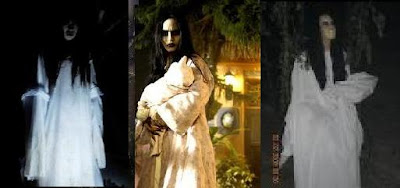
List names of famouse ghosts in asia

 1. Japan

     a. Hanakao-San

 Toire no Hanako or commonly known as the ghost Hanako toilet inhabitants, is one of the ghosts that popular among Japanese school children. Its popularity makes youkai Often is Often featured in the manga, anime, and movies. Each talking about toilets are fairly austere, even Japanese people associate with ghosts Hanako. Hanako Who exactly is it?.Gender: FemaleHeight: Around 120 cmWeight: UnknownCharacteristics: bob hair, red skirtWeapons: NoneHabitat: School ToiletMovement: Moving aroundHanako is actually a name that is quite old-fashioned to the name of a Japanese woman and had been a 'trend' in the past. Mentioned, Hanako ghost legend Began in the 1950's when it was a scene where the little boy in the toilet sightings school with a red skirt, short bob hair, and could Appear in the bathroom elementary schools in Japan. Urban legend says that at that time there was a little boy who was hiding in the school toilet from the pursuit of his mother crazy, but unfortunate he was found and killed by the mother. Other versions say that Hanako is a little boy who winner! Because of air raids of World War II, when he was playing hide and seek with his friend and hid in the toilet.

     b. Teke Teke

 Name: kashima ReikoOther names: Teke - Teke, Brick - brickArea: School toilets and places - other placesSpecial Strength: Can crawl quicklyDanger Level: DangerousInterests:?Doghouse:?

Kashima Reiko or Teke - Teke is a ghost or a phantom woman without legs are usually located in the school toilet japan. Tek - tek or Teke - Teke is one urban legend of the famous Japanese decent. Teke - Teke is a demon girl who fell from the train and therefore his legs cut off. And now his ghost haunts around Japan, dragging half of the body by using his hands like claws. So that every time he moves, he makes the sound "Tech ... Tech ...".
  
c. Kuchisake Onna

This legend is said to come from a young woman named Kuchisake Onna who lived hundreds of years ago as the wife or concubine of a samurai. This woman has a very pretty face, because it was the samurai said there will be no other woman will love.fire apparently unrequited love and betray the young woman samurai with cheating. When a dark secret known, the samurai would feel very jealous and furious immediately.His eyes darkened and lost his senses. He immediately drew his sword and cut the slit mouth woman from right ear to left ear. He then said, "Who would think that you are beautiful now?"Onna Kuchisake mouth gaping wide open, but no sound whatsoever coming out of his mouth. There was just blood rushing soaked robe. His eyes bulged and tears indicating that he was holding her extreme pain. But still there is no any sound coming out of his mouth.Left alone by the samurai for hours on end, until he died. Since the demise of curiosity, her spirit still haunt to keep looking for the samurai and demanded revenge. His nickname is Satan mouthed gap.Long story short, this legend passed down through the generations until now. The myth that there is now a myth that a woman exploring in the night with his face covered by a surgical mask.When he found a man, she will shyly ask, "Am I pretty?" ("Watashi Kirei?").If the person answers "yes," then he would take off his mask and said, "How about now?" ("Kore demo?"). At this point, if the victim answered "No," he would kill them or cut their mouths to resemble hers with scissors or a knife. But if the victim said she was still beautiful for the second time (after the woman opened the mask), he followed the victim to the house and killed them on the doorstep of their homes.

2. South Korea 

 1. Cheonyeo Gwishin (처녀 귀신), Virgin Ghost) 
Cheonyeo Gwishin can be called as well as its people Kuntilanak Korea (Korea is in the form of ghosts and long-haired woman in white). In the Korean legend, a young woman who died in a virgin will be bitter against his shame (shame because it was a virgin). Hence came the female ghosts who were around relatives and friends.
Korea ghost sightings described Cheonyeo Gwishin very long haired woman wearing a white dress (traditional Korean dress, hanbok), his face pale and blood dripping from the side of his mouth, korea ghost sightings can be seen as in the film The Ring Virus (Sadako mode on ). Because of its mission to get married are not met, then it is impossible for him to cross over into the afterlife. It is said that the ghost is condemned newlyweds, but it is also considered to bring ghost sickness or accident. The only way to get rid of ghosts korea is performing an exorcism ritual or by marrying a virgin ghost (Cheonyeo Gwishin) with ghost bachelor (Mongdal).


 2. Jeoseung Only (저승 사자), Angel of Death)  
Korea ghost Jeoseung Only or interpreted Representative of Jeoseung are subtle creatures that suck the soul and the souls guiding through the dark misty forest towards the hereafter (Korean version of the Grim Reaper). Jeoseung not heaven or hell, but it is the destination of the dead (called reverse Yiseung, or earth). 
Korea ghost sightings Jeoseung Just horrible as it is still a part of the cemetery and shamanism is still practiced in the rural areas. Traditionally, Korean ghost sightings Jeoseung only be described as an agent of a corrupt government that threatened to misuse of people died in custody, unless they are bribed with offerings.

 3. Dokkaebi


Dokkaebi is a common word for a type of spirit in Korean folklore or fairy tales.
The Dokkaebi is a mythical being that appears in many old Korean folktales. Although usually frightening, it could also represent a humorous, grotesque-looking sprite or goblin. These creatures loved mischief and playing mean tricks on bad people and they rewarded good people with wealth and blessings. They are different from ghosts (귀신) in that they are not formed by the death of a human being, but rather by the transformation of an inanimate object.


Different versions of the Korean Dokkaebi mythology assign different attributes to them. In some cases they are considered harmless but nevertheless mischievous, usually playing pranks on people or challenging wayward travellers to a ssireum (Korean wrestling) match for the right to pass.
Most Dokkaebi to carry a kind of club or mallet called a dokkaebi bangmang'i (도깨비 방망이). They are like magic wands, from which it can summon anything it wants. Unfortunately, when it gets something by using it, it gets things by "stealing" from someone else, because this bangmang'i can only summon existing things, and it doesn't create objects out of thin air.
Dokkaebi love to play games, especially ssireum as mentioned above. They are extremely good at it and one will never be able to beat them by trying to push them from the left side. However, they are very weak on the right side. In other stories one should hook their leg and push them to win, as they have only one leg.
Dokkaebi can also have a cap which is called dokkaebi gamtu (도깨비 감투). Its most well-known ability is that it gives the wearer invisibility.

3. China

1. vampire chinece version
 https://blogger.googleusercontent.com/img/b/R29vZ2xl/AVvXsEj1_RcJa8YDN6ET4ykuXHdW-P7iaqA7P4mzaokuMO_sHi5XXYcoOWO9gIP4fDgcD9lKWn92RQ8Ymq0oOx4t8VnxiW9QXfGvgQt4NJy-gnKxNm7V2I5-tVrX0WQVIPUR_y4Dy5MK-SmGFbg/s1600/hantucina.JPG
the undead-like man, dressed full Chinese tradition, preserved face and preening. Ghost moves by jumping while both her ​​hands straight forward. Jump distance versus ghost is said further pocong. It is argued, should Chinese Ghost caught or stopped its movement if the forehead. This creature is believed to rise from the grave / tomb of China because they spirits not at rest even though his body in meditation it perfectly. It is not pervasive but likes to Annoy People, Usually at night. Ghost half Chinese people believe that free is killing and eating humans as zombies, but there is no evidence to support that opinion firmly.

4.  Thailand 

1. Bajang

Bajang refers to a kind of strange spirits and maintained for the purpose of defeating the enemy. Bajang revered than dead babies die during birth. He is a male demon that often manifests as a cat pole cat. It is argued Bajang resembles a large weasel his deep eyes, wide and staring. Bajang often attacking childhood mystery and capable of causing disease that may be fatal to the prey nya.Bajang be escorted by their owners and will be stored in a reed tube. Some kind of special leaves to be used as a cap savings and locked to desist. Bajang issued only if the owners want to wear her foes.
 Bajang maintained it will be fed eggs and milk. If it were not maintained properly and fed, Bajang a hunger strike master. Bajang it will be avoided by using a talisman or amulet. There is no way to kill Usually bajang but if only master mind, he will be killed or driven from their homes Usually need it. Bajang inherited, and if only not handed down to Heirs, his master would be a lifeless corpse. His body was dead and stinking, but when about to be buried, it will rise as life. In addition, he will eat when fed greedily.


5. Indonesia

1.  Pontianak (kuntianak)

https://blogger.googleusercontent.com/img/b/R29vZ2xl/AVvXsEgwus9cRTHhnfdnPPKZrqCyfTx8iE2iF5z3ENCnj6rfmkh0hY0k7QIJVAo9IhdNEhNX5aAiVLg4REw8PDPHDholkRzwLqk9ecQ8cDkgr8rh6rZPV8BwhtKcWh4w7_5HNNVLZ_88noqXm3Y/s1600/pontianak.JPG 
 Pontianak is a creature that resembles a woman, dressed all in white, with long hair, often grinned and occasionally carrying tombstones wrapped like a baby. Pontianak are trusted by the Malay community than render pregnant woman who died when her son. There is also the opinion that free states it is the jinn / ghost of a vengeful wild and act annoying people.

2.  Pocong / ghost jumping candy / Punjut

 https://blogger.googleusercontent.com/img/b/R29vZ2xl/AVvXsEgD4BbV8YTg4bU2lNdUXbLpk9YebWFASDc9EOJNoY75MnPDFUHnxycveR_unwnxJhZpjNPDC4WGESCFWkRGj2Bzk21uR53-kGfHYL7nUsBSMIdAuY0tUnKn0Xtuvh7bbAP3f1B1S9Hc7fc/s1600/pocong.JPG
 Pocong Ghosts  also known as the Ghost Punjut referring to a type of creature shaped like a dead body wrapped in a shroud. Ghosts often said to harass wrap the weak spirit, and will move by leaping like a ghost china. He was said to be able to move as appropriate train, moving along with the train that is guided by their perturbed prey.

inspired: wikipedia.co.id
             http://mynonstopstories.blogspot.com/2012/07/kenali-jenis-jenis-hantu.html
follow: twitter.com/depoyS 
Created by: devi safitri 
             

Tuesday, 19 March 2013

Traditional House in Indonesia

In Indonesia, the construction of the house symbolizes the division of the macrocosm into three regions: the upper world, the seat of deities and ancestors. The typical way of buildings in Southeast Asia is to build on stilts, an architectural form usually combined with a saddle roof. Another characteristic of Southeast Asian houses is the forked horn on the roof, which is considered to be a symbol of the buffalo, regarded throughout the region as a link between Heaven and this world. The most famous stilt houses of Indonesia are those of the Dayak in Borneo, the Minangkabau and Batak on Sumatra, and the Toraja on Sulawesi.


The Long Houses of the Dayak:
Long House - before 1920, Tumbang Malahui, Central Borneo.


The Dayak, some of the original inhabitants of Borneo, build long houses on stilts, using ironwood for the structure and tree bark for the walls; the floor are simple planks of wood placed side by side. The length of these houses was for the last century of 110 meters (over 360 feet) and today they generally range from 10 to 70 meters (33 to 230 feet).
On Borneo the long house forms a center for both social life and for rituals. Here people meet to talk after work, and its here the central ceremonies and rituals of the group are performed.In each long house is a central stilt or main post which is the first to be placed in position when the house is built. This post is associated with the ancestor who founded the house has a sacred signifiance; it stands in the center of the house and its looked on as the link between the underworld and the upper world. The long houses were often decorated with representations of water snakes and rhinoceros birds. They were connected with the group's central creation myth, for water snake is associated with the underworld and the rhinoceros bird with the upper world of the good spirits.


The Houses of the Minangkabau:
Rice store - Minangkabau architecture, Pagaruyung near Bukit Tinggi, Sumatra.


The Minangkabau are the Malaysian people who lives in the Padang highlands of Sumatra (west of Sumatra). Typical of the houses of the Minangkabau are the distinctive roofs, which look like buffalo horns. The word "Minangkabau" can actually be interpreted as a compound of the words menang (win) and kerbau (buffalo). This derives from a local legends that people relates that a buffalo fight was arranged by the locals and the people of the influential kingdom of Majapahit (eastern Java). The loacls'buffalo was the winner and since that time they have called themselves the "buffalo winners", Minangkabau, as a proud testament to their strength and courage. The houses are called rumah gadang (large house) and are not inhabited by differents families, but by three or four generations who come from one ancestor and thus a rumah gadang is also a family unit, and each of the Minangkabau identifies completely with his or her own rumah gadang.
The rumah gadang has three main areas: immediately after the entrance comes a middle ares (rumah tongah), where there is normally a central post; adjoining this the anjuang, and the bedrooms (biliak). Opposite the anjuang is the kitchen and in front of that a large space (pangkalan), where visitors are received. While the long house is a meeting place for all, therumah gadang is essentially a women's area; none of the men spends much time in the house with his mother or his wife, and the biliak (bedrooms) are seen as room of the house reflects a woman's life cycle, and forms a journey from the central post to the anjuang, then the biliak, and lastly to the kitchen.


The Houses of the Batak:
The Batak, who live in north Sumatra, are divided into six ethnic groups. Two Bataks races, the Mandailing and the Angkola Batak, became Muslim in the middle of the 19th century, and Toba Batak were converted to Christianity in 1864 by the German Rheinisch Missionary Society. The others kept their native religion, though there have been converts to Islam and Christianity more recently.
"The houses of the Toba and Karo are recognizable by their massive style of building construction, which is suited to the way the inhabitants settled more and less permanently. The stilt house is an eminently pratical form of architecture for life in the tropics. Unfortunately, the Toba Batak houses are no longer being built. Earlier, rice stores (sopo) were a part of the traditional house, the rumah adat. The sopo were very important as status symbols.The ornaments put onto the external walls of the house are meant to drive away evil influences. These ornaments consist of anthropomorphic and zoomorphic representations, carved decorative ornaments, and wall paintings. The colors used are natural colors, the most iportant being red (from red clay), white (from chalk), and black (from charcoal), which respectively represent the three spheres of the cosmos: the human world, the world of good spirits above, and the underworld.
Batak house - Rumah adat, Lake Toba on the Island of Samosir.

The Houses of the Toraja:
The ethnic groups in the mountain regions of southwest and central Sulawesi (Celebes) are known by the name of Toraja, which has come to mean "those who live upstream" or "those who live in the mountains". Their name is in fact derived fromRaja, which in Sanskrit means "king". The society is hierarchically structured: the noblemen are called rengnge, the ordinary people to makaka, and the slaves to kaunan; birth determines which rank a person will occupy.
The distinctive features of the traditional houses (tongkonan) of the Toraja are the "buffalo horns", the roof design and the rich decoration on the walls. The buffalo is a symbol of status, courage, strength and fighting spirit.Designed as a representation of the universe, the tongkonan is constructed in three parts: the upper world (the roof), the world of humans (the middle of the building), and the underworld (the space under the floor). The highly distinctive roofs constructed by the Toraja have given rise to various ingenious interpretations. Certainly the roof is something of deep significance for the Toraja, and even today they build "modern" (in other words houses built with cement) houses with such roofs.
A tongkonan - Toraja area, Sulawesi (Celebes).


Twitter : @damnrell
edited by :  http://www.facebook.com/devi.hunter

Wednesday, 13 March 2013

Delicious Typical Food of Asian

1.  Tom Yam from Thailand

Tom yum or tom yam (Lao: ຕົ້ມຍຳ [tôm ɲam]; Thai: ต้มยำ, [tôm jam]) is a spicy clear soup typical in Laos and Thailand. Tom yum is widely served in neighbouring countries such as Malaysia, Singapore and Indonesia, and has been popularised around the world.
Literally, the words "tom yum" are derived from two Tai words: "tom" and "yam". "Tom" refers to boiling process (soup, in this case). "Yam" refers to a kind of Lao and Thai spicy and sour salad. Thus, "tom yum" is a Lao and Thai hot and sour soup. Indeed, tom yum is characterised by its distinct hot and sour flavours, with fragrant herbs generously used in the broth. The basic broth is made of stock and fresh ingredients such as lemon grass, kaffir lime leaves, galangal, lime juice, fish sauce and crushed chili peppers.
In neighbouring countries like Singapore, Malaysia and Indonesia, the name tom yum is used widely for various spicy soups which can differ greatly from true Lao and Thai tom yum soup. As a result, people are often confused by the disparities.

  2. Japan
a. Nikujyaga
 Nikujyaga is a stew that is rich in protein and carbohydrates are classically served in homes in Japan. Composition nikujyaga include potatoes, carrots, fish, meat, and other seasonings.

b. Onigiri
 O-nigiri (お握り or 御握り; おにぎ), also known as o-musubi, nigirimeshi (握り飯; にぎりめ) or rice ball, is a Japanese food made from white rice formed into triangular or oval shapes and often wrapped in nori (seaweed). Traditionally, an onigiri is filled with pickled ume (umeboshi), salted salmon, katsuobushi, kombu, tarako, or any other salty or sour ingredient as a natural preservative. Because of the popularity of onigiri in Japan, most convenience stores stock their onigiri with various fillings and flavors. There are even specialized shops which only sell onigiri to take away.

c. Yakiniku

Yakiniku , meaning "grilled meat", is a Japanese term which, in its broadest sense, refers to grilled meat dishes. "Yakiniku" originally referred to the "barbecue" of western food, which was given by Japanese writer, "Robun Kanagaki (仮名垣魯文)" in his literature, "Seiyo Ryoritsu (meaning "western food handbook")", in 1872 (The Meiji period). Meat has been eaten in Japan since the Jōmon period. However, the rise of Buddhism made the eating of meat tabooed, and consequently meat disappeared from the table from the middle ages to the Edo period.The term "yakiniku" became associated to Korean-influenced cuisine during the early Showa period. Due to the Korean War, Korean restaurants in Japan were divided into North Korean (Chōsen) and South Korean (Kankoku); "yakiniku restaurant" arose as a politically correct term to refer to restaurants of either type.


d. Okonomiyaki

 Okonomiyaki (お好み焼き o-konomi-yak) is a Japanese savoury pancake containing a variety of ingredients. The name is derived from the word okonomi, meaning "what you like" or "what you want", and yaki meaning "grilled" or "cooked" (cf. yakitori and yakisoba). Okonomiyaki is mainly associated with Kansai or Hiroshima areas of Japan, but is widely available throughout the country. Toppings and batters tend to vary according to region. Tokyo okonomiyaki is usually smaller than a Hiroshima or Kansai okonomiyaki.


3.  South Korea
a. Bibimbab
비빔밥 (bibimbap)
One of the most popular Korean dishes, bibimbap consists of a bowl of rice topped with fresh and cooked vegetables and red chili pepper paste. Everything is mixed together before eating which one mashes up with a spoon, stirring in your preferred quantity of gochujang (고추장 chili sauce). Seasoned raw beef, grilled beef, or a fried egg can also be added. Literally means "mixed rice", which is a pretty good description. Particularly tasty is dolsot bibimbap (돌솥비빔밥), served in a piping hot stone bowl that cooks the rice to a crisp on the bottom and edges.


b. Kimbab
 Gimbap or kimbap is a popular Korean dish made from steamed white rice (bap) and various other ingredients, rolled in gim (sheets of dried laver seaweed) and served in bite-size slices Gimbap is often eaten during picnics or outdoor events, or as a light lunch, served with danmuji or kimchi.


4.  pOLOs Pehi from Sri Lanka

 typical food in Sri Lanka during Ramadan are likely familiar with the tongue of the people of Indonesia. Has a very spicy, the cuisine is dominated by eggs, and processed grated coconut, onions and spices ingredients to another. In addition to the traditional cuisine, the food is also often seen as the main menu in various restaurant-restaurant which is quite luxurious in the country's largest producer of graphite World.


5. Pakora from India 
  If we were in India, a country known for one of the world thanks to the Taj Mahal is also a tradition of breaking the typical menu. Generally, during Ramadan, local residents connect with their food menu called by the name of pakora. 
Pakora is one of the typical Indian food. Lunch is served with a simple but very compelling. Shaped like a fried mushrooms, consisting of flour and spices as dough, and vegetables such as broccoli or onions, food is often used as a typical takjil Indian Society in Ramadan.


source by:
http://www.centroone.com/index.php/lifestyle/2012/08/1a/menu-berbuka-khas-di-berbagai-negara
http://wiki.galbijim.com/Bibimbap 
http://www.facebook.com/permalink.php?story_fbid=399232226836895&id=390712747688843 
created by : http://www.facebook.com/devi.hunter
                   https://twitter.com/DepooyS