Showing posts with label Thailand. Show all posts

Monday, 6 May 2013

Thailand - Thai Language, Culture, Etiquette

Facts and Statistics
  • Location: Southeastern Asia, bordering the Andaman Sea and the Gulf of Thailand, southeast of Burma
  • Capital: Bangkok
  • Climate: tropical; rainy, warm, cloudy southwest monsoon (mid-May to September); dry, cool northeast monsoon (November to mid-March); southern isthmus always hot and humid
  • Population: 64,865,523
  • Ethnic Make-up: Thai 75%, Chinese 14%, other 11%
  • Religions: Buddhism 95%, Muslim 3.8%, Christianity 0.5%, Hinduism 0.1%, other 0.6% (1991)
  • Government: constitutional monarchy
  • Languages in Thailand : The Thai language is comprised of 44 consonants, 32 vowels and five tones in Thai pronunciation, along with a script that has Indian origins. The Thai language, belonging to the Tai family, is the main language in Thailand although there are several regional dialects as well.  Other languages spoken in Thailand are Chinese, Lao, Malay and Mon-Khmer, while English use is becoming more prevalent in government and commerce. English is also being taught as a second language in secondary school and universities, which enables the English speaking visitor in Thailand to have little trouble conversing.


Thai Society & Culture

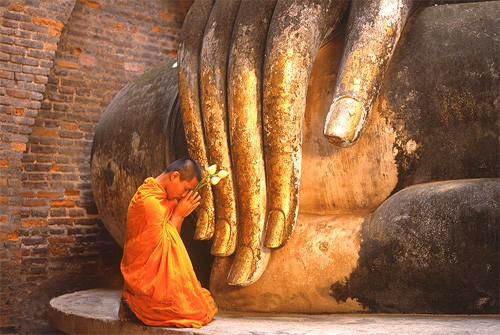
  • The Wai
  1. The wai is the common form of greeting and adheres to strict rules of protocol. 
  2. Raising both hands, palms joined with the fingers pointing upwards as if in prayer, lightly touching the body somewhere between the chest and the forehead, is the standard form. 
  3. The wai is both a sign of respect as well as a greeting. Respect and courtesy are demonstrated by the height at which the hands are held and how low the head comes down to meet the thumbs of both hands.
  4. The wai may be made while sitting, walking, or standing.
  5. The person who is junior in age or status is the first one to offer the wai. 
  6. The senior person returns the wai, generally with their hands raised to somewhere around their chest. 
  7. If a junior person is standing and wants to wai a senior person who is seated, the junior person will stoop or bow their head while making the wai. 
  8. If there is a great social distance between two people, the wai will not be returned.
  • Buddhism in Thailand
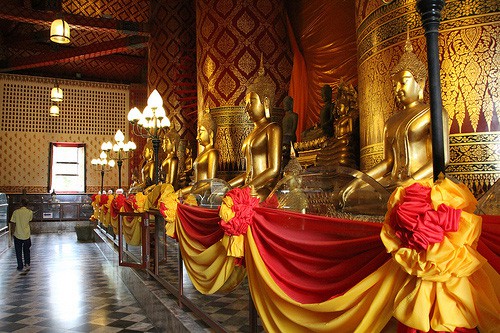
  1. Thailand is a stronghold of Buddhism. 
  2. Buddhists believe that life does not begin with birth and end with death, but rather that every person has several lives based upon the lessons of life not yet learned and acts committed (karma) in previous lives. 
  3. Buddhists believe that selfishness and craving result in suffering and that compassion and love bring happiness and well-being. 
  4. The true path to peace is to eliminate all desire, a condition which Buddhists define as 'nirvana', an indescribable state free of desire, suffering, or further rebirth, in which a person simply is, and is completely at one with his surroundings. 
  5. Buddhism is practised in Thailand by over 90% of the population.
  • Hierarchical Society
  1. Thais respect hierarchical relationships. 
  2. Social relationships are defined as one person being superior to the other. 
  3. Parents are superior to their children, teachers to their students, and bosses to their subordinates. 
  4. When Thais meet a stranger, they will immediately try to place you within a hierarchy so they know how you should be treated. 
  5. This is often done by asking what might be seen as very personal questions in other cultures. 
  6. Status can be determined by clothing and general appearance, age, job, education, family name, and social connections.
  • Thai Family Values
  1. The family is the cornerstone of Thai society. 
  2. Family life is often more closely knit than in western cultures. 
  3. The Thai family is a form of hierarchy with the parents at the top. 
  4. Children are taught to honour their parents.
  • Thai Demeanour
  1. Thais place great emphasis and value on outward forms of courtesy such as politeness, respect, genial demeanour and self-control in order to maintain harmonious relations. 
  2. Many of their rules of etiquette are by-products of the Buddhist religion. 
  3. It is a non-confrontational society, in which public dispute or criticism is to be avoided at all costs. 
  4. To be openly angry with someone might attract the wrath of the spirits, which in turn could cause violence and tragedy. 
  5. Openly criticizing a person is a form of violence as it hurts the person and is viewed as a conscious attempt to offend the person being rebuked
  6. Loss of face is a disgrace to a Thai so they try to avoid confrontations and look for compromises in difficult situations. 
  7. If two parties disagree, one will need to have an outlet to retreat without losing face.

Etiquette & Customs in Thailand

  • Meeting Etiquette 
  1. The wai (as mentioned above) is the traditional form of greeting, given by the person of lower status to the person of higher status. 
  2. Thais generally use first rather than surnames, with the honorific title Khun before the name. Khun is an all- purpose form of address that is appropriate for both men and women
  3. In general, wait for your host and hostess to introduce you to the other guests. This allows everyone to understand your status relative to their own, and thus know who performs the wai and how low the head should be bowed.
  • Gift Giving Etiquette
  1. If invited to a Thai's home, a gift is not expected, although it will be appreciated. 
  2. Gifts should be wrapped attractively, since appearance matters. Bows and ribbons add to the sense of festivity. 
  3. Appropriate gifts are flowers, good quality chocolates or fruit. 
  4. Do not give marigolds or carnations, as they are associated with funerals. 
  5. Try to avoid wrapping a gift in green, black or blue as these are used at funerals and in mourning. 
  6. Gold and yellow are considered royal colours, so they make good wrapping paper. 
  7. Only use red wrapping paper if giving a gift to a Chinese Thai. 
  8. Gifts are not opened when received. 
  9. Money is the usual gift for weddings and ordination parties.
  • Dining Etiquette
    If you are invited to a Thai's house:
  1. Arrive close to the appointed time, although being a few minutes late will not cause offence. 
  2. Check to see if the host is wearing shoes. If not, remove yours before entering the house. 
  3. Ask another guest to confirm the dress code. 
  4. Step over the threshold rather than on it. This is an old custom that may be dying out with younger Thais, but erring on the side of conservatism is always a good idea.

by. Darrell E.F (@damnrell)

Tuesday, 5 March 2013

Sak Yant, Tattoo Sorcerer of Thailand


Tatto Yantra, also called Sak Yant (Thai: สัก ยัน ต), is a form of sacred tattoos are practiced in Southeast Asian countries including Cambodia, Laos, and Thailand practice is also starting to grow in popularity among Chinese Buddhists in Singapore.

Sak means "to tap [tattoo]", and yant derived from the Sanskrit word yantra, means "sacred geometrical design." Sak Yant designs are usually tattooed by Wicha (magic) practitioners and Buddhist monks, traditionally with a long bamboo stick sharpened (called mai sak) or alternatively with a long metal needle (called sak Khem)
.
 
http://anehdankonyol.com 
Script used for yantra designs is a mixture of ancient Khmer script and the original Buddhist / Pali script. History shows that the yantra tattoo comes from the Angkor era. Different designs have been added to this design over the years through visions received in their meditations.
Some yantra designs have been adapted from pre-Buddhist Shamanism and the belief in the spirits of the animals found in Southeast Asia continent and incorporated into the tradition and culture of Thailand. Yantra tattoos are believed to have mystical magic and provide power, protection, or success.

In Cambodia, the tattoo is used for self-protection. Cambodians believe a yantra has magical powers that ward off evil and suffering. tatto is especially popular among military personnel. tatto allegedly guarantees that the person can not receive physical damage as long as they observe certain rules.


Yant design is also applied to other media, such as cloth or metal, and placed in a home, place of worship, or vehicle as a means of protection from all sorts of dangers, protection from disease, increased wealth, or attract lovers.

Of the countries in Asia where yantra tattoo done, Thailand is by far the country with the highest number. Sak yant done throughout the country in temples in Bangkok, Ayutthaya, and northern Thailand. One of the most famous temples on this day for yantra tattoo is Wat Bang Phra in Nakhon Chaysri, Nakhon Pathom province, Thailand.
 
By : Friska Aprilda

Saturday, 2 March 2013

The Top Places in Thailand


The Top 10 Places in Thailand

photo: Mark Fischer
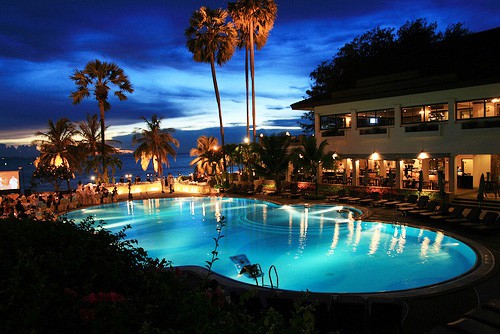
One of the most popular tourism destinations in Southeast Asia, Thailand is a country with a fascinating history, a devout Buddhist culture and beautiful scenery that lures travelers from all over the world.
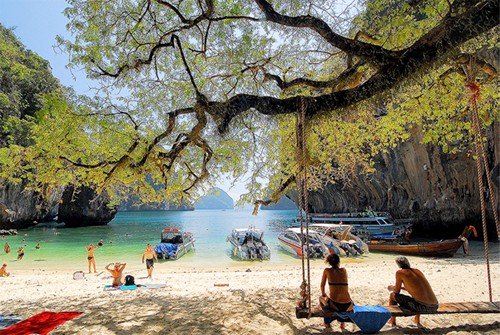
For many cultural travelers it is a land of ancient temples, glittering spires and beautiful palaces. For sun-seeking hedonists it is a place to rejuvenate on palm-studded beaches that rim idyllic bays and islands. For international foodies it is a culinary mecca whose restaurants and sidewalk food stands keep coming back for more
Bangkok, a huge metropolis replete with traffic and shopping centers worthy of any international capital, contrasts sharply with the rice paddies out on the plains, the idyllic villages in the hills and mountains or the beach-side reggae bars in Phuket. Bit it’s this very diversity that’s makes the country so appealing for so many, from burned-out executives who jet here to unwind at sybaritic five-star resorts, to backpackers who wander through to experience the local culture while staying at low-cost guesthouses in Bohemian-like Chiang Mai.
Below is a listing of the “Top 10″ most-visited places in Thailand as reported by the Tourism Authority of Thailand.

photo: Swaminathan
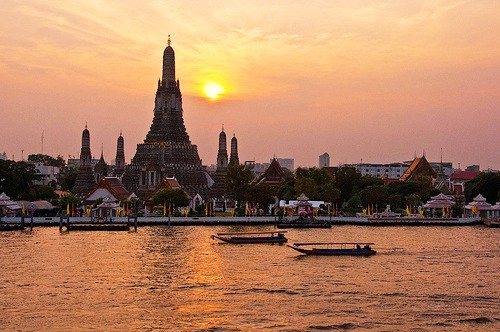
1. Bangkok
As the political, economic, cultural, culinary, and spiritual capital of Thailand, Bangkok features both old-world charm and modern convenience. Invariably, every Thailand holiday includes a visit to the kingdom’s capital city, Bangkok, or Krung Thep, “the city of angels” as it’s known to the locals. Many first-time visitors to the city are overwhelmed by its sheer size; others by the vast number of attractions scattered about the city, the result of more than two centuries of rapid development following the city’s founding in 1782. Today Bangkok is a cosmopolitan, 21st century city of more than ten million inhabitants.

photo: Dennis Jarvis
2. Chiang Mai
Thailand’s “Rose of the North” contains both cultural and natural diversity, a multitude of attractions, and welcoming hospitality. Chiang Mai literally means “new city” and has retained the name despite celebrating its 700th anniversary in 1996. King Meng Rai the Great, a very religious leader who founded many of the city’s temples, created the city as the capital of the Lanna Kingdom around the same time as the establishment of the Sukhothai Kingdom. Chiang Mai not only became the capital and cultural core of the Lanna Kingdom, but also the center of Buddhism in northern Thailand.

photo: rajkumar1220
3. Phuket
When travelers to Thailand talk about sea, sun and sand, Phuket is often the first place that comes to mind. Catapulted to international attention by the James Bond movie “The Man with the Golden Gun” back in 1974, the entire area today boasts many hotels and resorts, which offer all sorts of tourism facilities for travelers.

photo: David Rubin
4. Ayutthaya
Once considered the most spectacular city on Earth, the ruins of the capital of the Kingdom Ayutthaya are now a major tourist attraction easily accessible from Bangkok by car, train, or boat as either a daytrip or overnight excursion. A regional power for 417 years, the ancient city its apex in the 16th century, when the Kingdom’s territory extended into and beyond present-day Laos, Cambodia, and Myanmar. Ayutthaya had diplomatic relations with Louis XIV of France and was courted by Dutch, Portuguese, English, Chinese and Japanese merchants.

photo: Tourist Authority of Thailand
5. Kanchanaburi
Kanchanaburi has become a major tourist destination, with a focus on the outdoors due to its magnificent landscape and charming beauty. Only two hours from Bangkok, Kanchanaburi is accessible by road or rail, and is popular for fishing, rafting, canoeing, mountain biking, bird-watching, star-gazing, golfing and elephant and jungle trekking. The area boasts several well-known waterfalls, caves that were once inhabited by Neolithic man, national parks, tranquil rivers, virgin forests, and several large reservoirs.

photo: Tourist Authority of Thailand
6. Krabi
a province on southern Thailand’s Andaman coast, is an almost otherworldly region of labyrinthine archipelagos, where islands seem to erupt vertically out of the sea and secluded beaches are only accessible by colorfully adorned long tail boats. Krabi’s myriad of bays and coves have sheltered pirates, merchants, and sea gypsies for thousands of years and archaeological evidence indicates that Krabi was originally inhabited as early as 25,000 – 35,000 years ago.

photo: Tom Marshall
7. Ratchaburi
Ratchaburi’s premier attraction is the Damnoen Saduak Floating Market, a destination visited by a large percentage of tourists who visit Bangkok. Vendors in the market sell their wares by paddling boats along Ratchaburi’s canals. Every morning, hundreds of boats crowd the market, paddled by women in straw hats. For a few hundred baht visitors can hire their own boats and explore the canals while shopping for everything from vegetables and fruits to freshly-cooked noodles and souvenirs.

photo: Michael Adams
8. Chon Buri
Chonburi, Bangkok’s nearest seaside town, is located on the eastern coast of the Gulf of Thailand, about 50 miles from the capital. The area boasts abundant natural resources, making it a popular coastal province among Bangkokians who seek a weekend. Particularly popular is the seaside resort of Pattaya, though Chonburi’s smaller, quieter seaside towns are also quite popular with foreigners and Thais alike.

photo: Tourist Authority of Thailand
9. Sukhothai
Founded in the 13th century, Sukhothai, which literally means “Dawn of Happiness”, was the first truly independent Thai Kingdom and enjoyed a golden age under King Ramkhamhaeng, who is credited with creating the Thai alphabet. The superb temples and monuments of this great city have been lovingly restored, and Sukhothai Historical Park, a UNESCO World Heritage Site, is popular with travelers, particularly on those occasional nights the park when the park remains open and the graceful Buddhas are illuminated by lights.

photo: Tourist Authority of Thailand
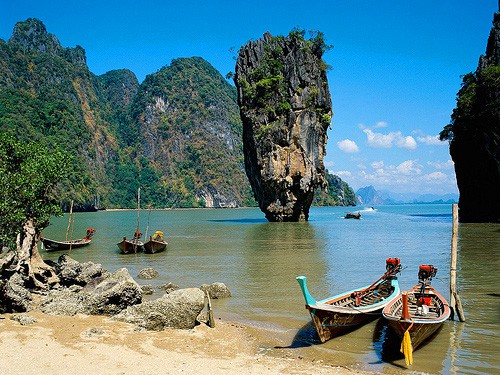
10. Phang nga
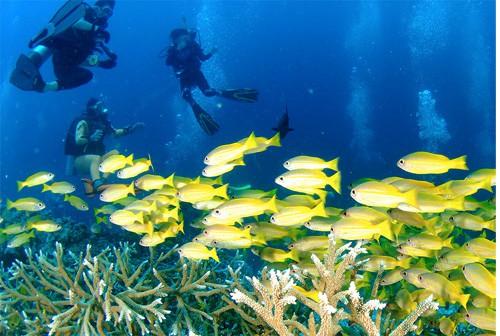
Phang Nga province renowned for its beautiful land, spectacular bay, amazing islands and good diving. Most famous is Phang Nga Bay National Park, a geological wonder filled with islets, sunken caverns, and startling rock formations rising vertically out of the sea. The bay is extremely sheltered and therefore ideal for expeditions on sea kayaks to explore the many fascinating caverns and islands throughout the bay.


-Twitter/Instagram : @damnrell

Wednesday, 6 February 2013

A Crazy Little Thing Called Love (Review): Based on a True Story of Everyone

High School. Sort of.
Dark skinned, with glasses and braces =
the complete cliche package of an ugly
girl falls in love with unbelievably
handsome and charming upperclassman.
Of course he has to be perfect in every
way possible, all sensitive and artistic (but athletic and hot at the same time) while she is the clumsy nerd in the shadows.
The movie opens up with Nam's quirky
group of friends and a teacher who is
too straightforward for her own good.
A few juvenile scenes of picking out
crushes, passing notes during class and
stolen glimpses and suddenly, the story
becomes all too familiar.
All those enchantment-believing, book-
reading and daydreaming moments
could might as well be anybody else's
story and it was that gravitation to
something so recognizable to all, I
think, that made this movie so popular
and endearing to people who have a
heart and once used it for something
no matter how one-sided and futile the
experience was.
But of course the lead character must
shed off her veil of ugliness and become
this pretty swan in a matter of a few
months. Any story set on screen could
definitely not end with the Prince
Charming falling in love with the still
visually despicable commoner! The
transformation was so dramatic I had
to Google if two different actresses
played her part.
I found it bothersome how society
(apparently even in Thailand) entails
that for a character to be noticed and
loved, she has to be physically
beautiful. Yes it's nice that after a lot
of name-callings and schoolyard
torture, the caterpillar that we have
grown accustomed to has wreathed out
of her cocoon and transformed into a
beautiful butterfly. But still, wouldn't
it be more interesting, and inspiring
even, if the Prince Charming and the
ordinary girl had their happily ever
after without some cliche make-over /
metamorphosis in the middle to make
everything easier on the eyes?
For me, it was a rocky road from the
moment Nam became painfully
beautiful. She suddenly lost her
adorable awkward charm and it was
not as interesting seeing her being
fawned upon by random schoolmates.
Fortunately, the story picked up near
the ending with humiliating confessions,
predictable heartbreak and some
flipping through a black book.
Overall, it is a must-see for everyone
who have gone through high school
and/or puberty. I guaranty you will
relieve those tiled school halls with
such clarity it's disconcerting. The
trailer got it right when it said that it
is based on a true story of everyone.
And I find myself agreeing with that
claim. At least for the first 30
minutes. ;)

Follow me :
Instagram : RonnyGanger
Twitter : RonnyGnawan